
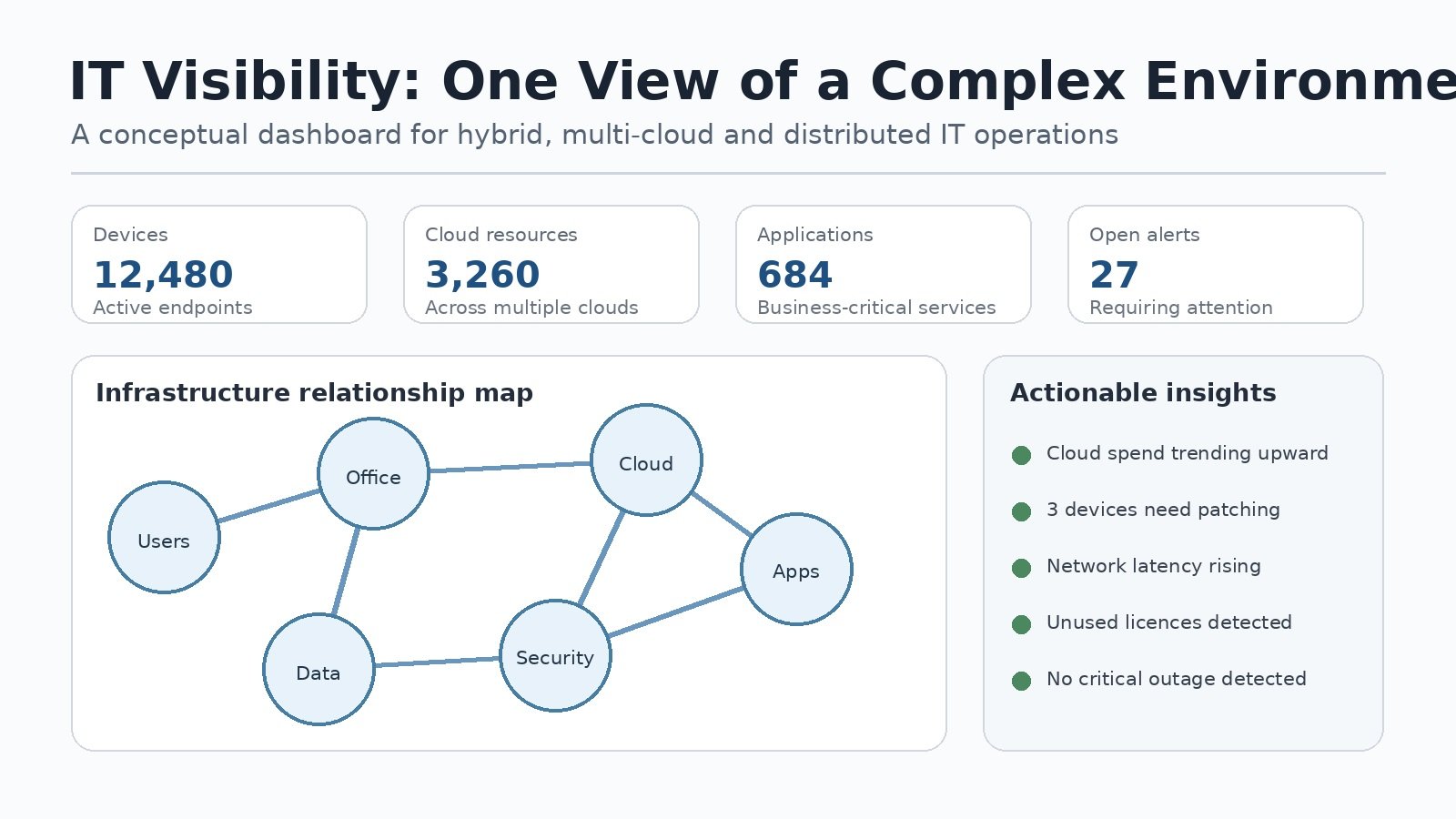
Why Visibility Matters for Managing Complex IT Infrastructure in the UK and US
Modern businesses rely on technology for almost everything, from customer communication and online sales to employee collaboration, data storage, cybersecurity, and daily operations. As companies grow, their IT environments often become more complicated. Cloud platforms, remote devices, SaaS applications, networks, servers, APIs, and third-party services can all become part of the same technology ecosystem.
This is exactly why Visibility Matters.
When IT teams cannot clearly see what is happening across their technology environment, even a small problem can become difficult to identify and expensive to fix. Businesses in both the UK and US are increasingly managing hybrid infrastructure that combines on-premises systems, private and public clouds, remote work environments, and external technology providers.
In this environment, Visibility Matters because it gives businesses the information they need to understand their systems, identify risks, improve performance, and make better technology decisions.
What Does IT Visibility Actually Mean?
IT visibility is the ability to see, understand, and monitor the different components of an organisation’s technology environment.
It goes beyond simply knowing that a company has a collection of computers, applications, and servers. Effective visibility provides insight into how those systems are connected, how they are performing, where problems are occurring, and how changes in one area may affect another.
For example, an IT team might discover that an application is running slowly. Without sufficient visibility, the team may spend hours investigating the application itself. With better visibility, they might quickly discover that the real problem is network congestion, an overloaded cloud resource, a database issue, or a third-party service.
This demonstrates why Visibility Matters in modern IT management. The more complex an environment becomes, the harder it is to manage without accurate information.
Why Visibility Matters as IT Environments Become More Complex
Businesses rarely operate with a single technology platform anymore. A typical organisation may use Microsoft 365 or Google Workspace for productivity, cloud infrastructure from providers such as AWS or Microsoft Azure, CRM platforms, accounting software, cybersecurity tools, collaboration applications, and specialist SaaS products.
Employees may also access these systems from offices, homes, mobile devices, and locations around the world.
This complexity creates more opportunities for problems to occur.
An organisation may have outdated software that has not been properly documented. An employee may still have access to an application they no longer need. A cloud resource may be consuming more money than expected. A network device may be approaching capacity.
Without a complete picture, these issues can remain hidden.
That is why Visibility Matters when businesses are trying to maintain reliable and efficient IT infrastructure.
Better Visibility Supports Smarter Technology Decisions
Technology decisions can involve significant investment. Whether a company is moving applications to the cloud, upgrading its network, replacing hardware, or adopting a new cybersecurity platform, decision-makers need reliable information.
Poor visibility can lead to assumptions.
For example, a business might believe it needs additional infrastructure because users are reporting performance problems. However, detailed monitoring could reveal that the real issue is inefficient software configuration rather than insufficient hardware.
Similarly, a company may consider replacing a technology platform without fully understanding how many teams depend on it or how it integrates with other applications.
This is another area where Visibility Matters. Reliable information helps organisations make decisions based on evidence rather than guesswork.
Visibility Matters for Managing Cloud Infrastructure
Cloud computing has transformed how businesses build and operate technology environments. UK and US organisations can scale computing resources quickly without maintaining every physical server themselves.
However, cloud infrastructure can also introduce new management challenges.
Businesses may have resources spread across multiple accounts, regions, platforms, or cloud providers. Development teams may create resources for testing, while other departments may subscribe to SaaS applications without central IT involvement.
As cloud environments expand, it becomes increasingly difficult to understand exactly what is being used and how much it costs.
Visibility Matters here because organisations need to know which resources exist, who owns them, how they are performing, and whether they are still necessary.
Better visibility can also help identify unused resources and unnecessary spending, giving businesses an opportunity to improve cloud cost management.
Improving Cybersecurity Through Greater IT Visibility
Cybersecurity is another major reason Visibility Matters.
A security team cannot effectively protect systems it cannot see. Unknown devices, outdated software, unusual login activity, misconfigured cloud services, and unauthorised applications can all create potential security risks.
A strong visibility strategy helps security and IT teams understand what is connected to the organisation’s environment.
For example, if an unfamiliar device appears on a corporate network, visibility tools can help teams identify it and investigate whether it is legitimate. Similarly, monitoring can highlight unusual behaviour that may deserve further investigation.
Visibility does not eliminate cybersecurity risks, but it can give security professionals the information required to identify and respond to them more effectively.
Visibility Matters for Remote and Hybrid Work
The growth of remote and hybrid work has changed IT management considerably in both the UK and US.
Employees may now work from home, offices, coworking spaces, hotels, or other locations. Their devices connect through different networks and may rely on cloud-based applications rather than traditional office infrastructure.
This creates a challenge for IT teams.
A company may have excellent visibility inside its office network but limited insight into what happens when employees work remotely.
Modern monitoring and management tools can help provide a broader view of devices, applications, connectivity, and user experiences.
For organisations supporting distributed workforces, Visibility Matters because technology teams need to understand performance beyond the traditional office environment.
Reducing IT Downtime and Operational Disruption
Few things are more frustrating for a business than an unexpected technology outage.
When an important application stops working, employees may be unable to complete their tasks. Customers may experience service interruptions, and businesses can lose revenue or damage customer confidence.
The challenge is not always the outage itself. Sometimes the bigger problem is identifying its cause.
A lack of visibility can force IT teams to investigate multiple systems manually. This takes time and can delay recovery.
With better monitoring, teams can identify performance changes, unusual activity, or infrastructure failures earlier.
This is one of the practical reasons Visibility Matters: it can help IT teams move from reactive troubleshooting toward proactive management.
Controlling Technology Costs
Technology spending can become difficult to track as organisations grow.
Businesses may pay for cloud services, software subscriptions, hardware, support contracts, security products, connectivity, and external technology services.
Some of these expenses can become hidden over time.
For example, a business might continue paying for SaaS licences assigned to employees who have left the company. It might also maintain cloud resources that are rarely used.
Greater visibility can reveal these inefficiencies.
When finance and IT teams have a clearer understanding of technology usage, they can have more informed conversations about budgets and investment.
Again, Visibility Matters because cost optimisation requires an accurate understanding of what the organisation is actually using.
Visibility Matters for IT Asset Management
Knowing what technology an organisation owns or operates sounds simple, but it can become surprisingly difficult at scale.
A growing company might have laptops, desktops, mobile devices, servers, network equipment, cloud resources, software licences, and virtual machines distributed across different locations.
Without accurate asset information, organisations may struggle to answer basic questions.
What devices are currently active?
Which systems are approaching the end of their useful life?
Which applications are installed?
Who is responsible for a particular system?
Which assets require security updates?
These questions highlight why Visibility Matters for effective asset management. A reliable technology inventory gives IT teams a stronger foundation for maintenance, budgeting, compliance, and security.
Supporting Compliance and Governance
Businesses operating in the UK and US may need to meet various regulatory, contractual, privacy, or industry-specific requirements.
Compliance requirements differ depending on the organisation, sector, location, and type of information being processed. However, many governance programmes require organisations to understand where data and systems exist and how they are managed.
Strong IT visibility can support these activities by helping businesses document technology environments, identify relevant systems, monitor access, and maintain appropriate records.
Visibility is not a substitute for a complete compliance programme, but it can make governance activities easier to manage.
Breaking Down IT Silos
Another reason Visibility Matters is that technology information is often fragmented between departments.
The networking team may have one set of monitoring tools. The security team may use another. Cloud engineers may rely on separate dashboards, while finance teams track technology spending elsewhere.
When information remains isolated, it becomes harder to understand the complete technology environment.
A broader visibility strategy can help teams work from shared information.
This can improve communication between IT operations, cybersecurity, finance, management, and other departments.
Turning IT Data Into Business Insight
Collecting data is not enough.
Businesses need to turn technology data into information that supports practical decisions.
For example, an IT dashboard might show that application performance has declined. The next question should be why it declined and what the business impact might be.
Similarly, a cloud report might show increasing spending. Decision-makers then need to understand whether the increase is linked to business growth, inefficient resource usage, or an unexpected configuration.
This is where Visibility Matters most. The goal is not to collect endless technical information. The goal is to create a clear understanding of what is happening and why it matters to the business.
Building a More Proactive IT Strategy
Traditional IT management has often been reactive. A problem occurs, users report it, and the IT team investigates.
Modern infrastructure requires a more proactive approach.
By continuously monitoring systems and identifying trends, IT teams can detect potential problems before they become major disruptions.
For example, an organisation may notice that storage capacity is steadily increasing. Instead of waiting for the system to reach its limit, the IT team can plan an upgrade or optimisation strategy.
This proactive approach is another reason Visibility Matters for organisations that want technology to support long-term growth.
How UK and US Businesses Can Improve IT Visibility
Improving visibility does not necessarily mean purchasing dozens of new tools.
Businesses can begin by creating a clear inventory of their technology environment. This should include devices, applications, cloud resources, networks, important services, and third-party platforms.
The next step is to identify the areas where visibility is currently weakest.
Organisations can then establish appropriate monitoring, asset management, security, and reporting processes.
It is also important to connect technical information with business priorities. IT teams should understand which systems are most critical to customers, employees, revenue, and operations.
Finally, visibility should be treated as an ongoing process rather than a one-time project.
Technology environments change constantly, so the information used to manage them needs to remain current.
The Future of IT Management Depends on Better Visibility
Technology infrastructure will continue to evolve.
Artificial intelligence, cloud computing, automation, edge technologies, connected devices, and distributed workforces are creating increasingly interconnected environments.
As this happens, IT teams will have more systems to manage and more information to process.
The organisations that can turn that complexity into a clear and understandable picture will be better positioned to manage their technology environments effectively.
That is why Visibility Matters today and will continue to matter as technology becomes more deeply integrated into business operations.
Conclusion
Complex IT infrastructure is now a normal part of doing business in the UK and US. From cloud platforms and remote devices to SaaS applications and cybersecurity systems, organisations have more technology to manage than ever before.
Without a clear view of that environment, businesses can struggle with security risks, unexpected costs, performance problems, downtime, and poor technology decisions.
Visibility Matters because it gives IT and business leaders the information needed to understand their infrastructure and make informed choices.
The objective is not simply to see more data. It is to understand what that data means, identify what requires attention, and connect technology performance with business priorities.
For organisations preparing for the next stage of digital growth, better IT visibility can provide the foundation for more informed, proactive, and efficient technology management.
editor's pick
latest video

news via inbox
Nulla turp dis cursus. Integer liberos euismod pretium faucibua