
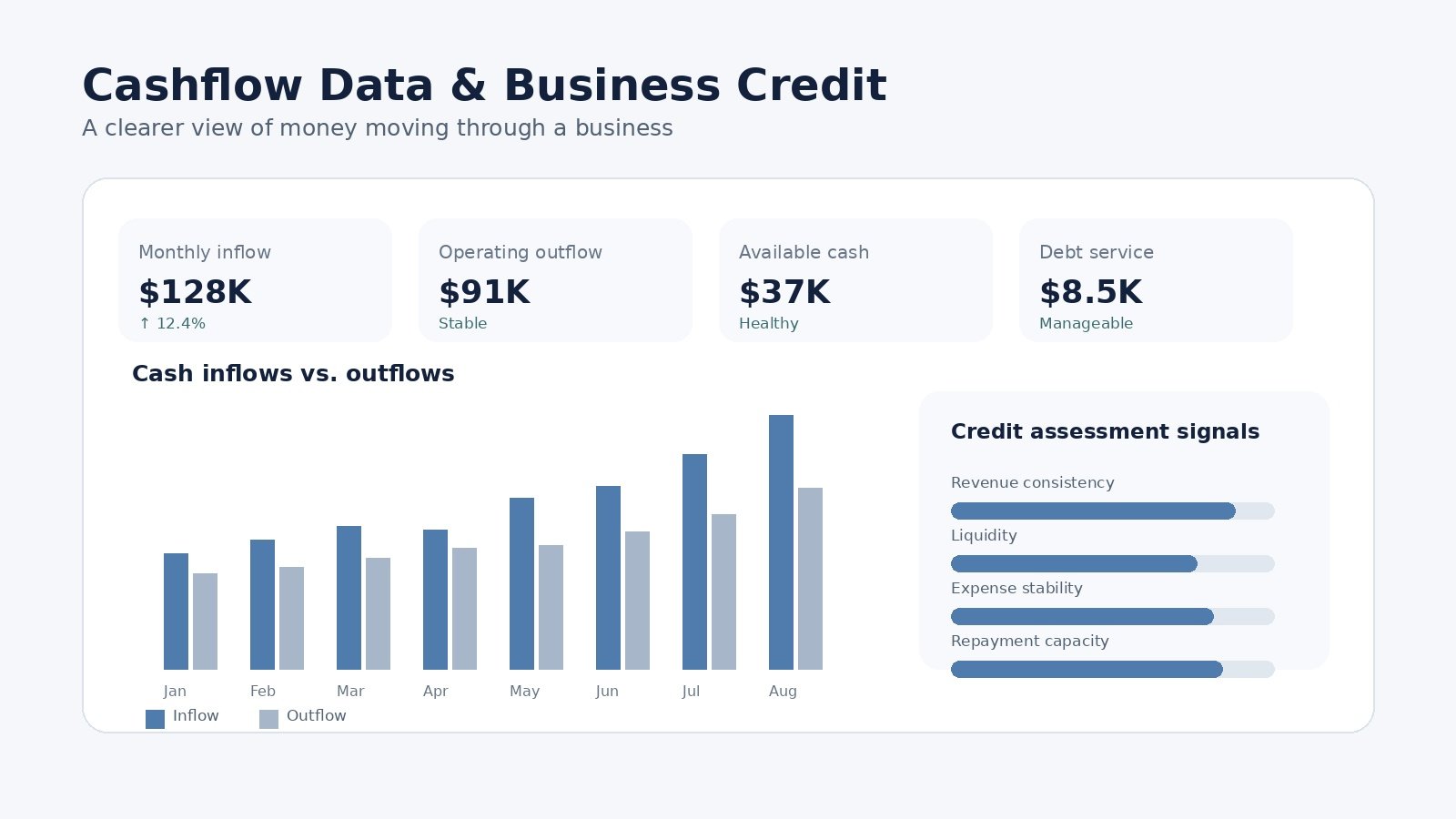
Why Cashflow Data Is Changing How Businesses Access Credit in the UK and US
Introduction
For years, business lending has relied heavily on credit scores, financial statements, tax returns, and lengthy application processes. These tools still have an important role, but the way modern businesses manage money has changed dramatically.
Today, companies receive customer payments digitally, pay suppliers online, manage subscriptions, use payment platforms, and move money between accounts almost instantly. All of these activities create a much richer picture of a company’s financial health.
This is where Cashflow Data is becoming increasingly important. Rather than looking only at historical credit information, lenders can examine how money actually moves through a business. This can provide valuable insight into revenue, expenses, liquidity, and repayment capacity.
In both the UK and US, this shift is changing how businesses demonstrate their financial strength and how lenders approach credit decisions.
What Is Cashflow Data?
Cashflow Data refers to information showing how money enters and leaves a business over a particular period. It can include customer payments, payroll, rent, supplier invoices, subscriptions, loan repayments, transfers, and recurring operating expenses.
The key difference is that Cashflow Data focuses on actual financial activity rather than relying entirely on historical credit information. A lender may be able to identify whether revenue is consistent, whether expenses are increasing, how much cash is normally available, and whether a company regularly experiences financial pressure.
For example, a small UK retailer may have a limited borrowing history but several years of stable digital transactions. Similarly, a US software company may be relatively young while generating predictable monthly subscription revenue.
That financial activity can tell lenders something that a traditional credit score may not fully capture.
Why Traditional Credit Assessment Is Changing
Traditional credit assessment was built around information that could be collected and standardised relatively easily. Credit reports and financial statements remain useful, but they do not always provide a complete picture of a company’s current position.
A credit score can indicate how a business or its owners have handled credit in the past. However, it may not show what is happening inside the business today. Financial statements provide more detail, but they are often prepared periodically rather than continuously.
Cashflow Data adds another layer to this process. It can give lenders a closer look at current financial behaviour, liquidity, income patterns, and spending.
For businesses, this can be particularly useful when a company has strong day-to-day performance but a relatively short credit history.
How Cashflow Data Helps Lenders Understand Risk
Every lending decision involves risk. The challenge for lenders is determining whether the information available provides a reliable picture of a borrower’s ability to repay.
Cashflow Data can help lenders identify patterns instead of focusing on individual figures. They may examine revenue consistency, average balances, expense trends, payment timing, recurring obligations, and unusual changes in account activity.
Imagine two businesses applying for similar amounts of credit. Both might have comparable credit profiles, but one could have stable monthly revenue and predictable expenses while the other experiences significant fluctuations and frequent cash shortages.
Transaction-level information can help highlight these differences.
This does not eliminate lending risk or replace responsible underwriting. Instead, it gives lenders another source of evidence when assessing a business.
Benefits for Small and Growing Businesses
Small businesses often face a frustrating situation: they need funding to grow, but they may not have the long credit history, assets, or extensive financial records expected by conventional lenders.
Cashflow Data can help address part of this gap by showing real-world business activity. A company with consistent incoming payments and well-managed expenses may be able to present a stronger financial picture than its traditional credit history suggests.
This can be relevant to startups, independent retailers, contractors, professional service providers, ecommerce companies, and other growing businesses.
In the UK, open banking has helped create an environment in which financial information can be shared with authorised providers when customers give appropriate consent. In the US, financial technology platforms are also making bank and transaction information increasingly accessible for approved financial services use cases.
This creates opportunities for lending decisions to consider a broader range of financial information.
Faster Credit Decisions
One of the most noticeable advantages of Cashflow Data is the potential to speed up parts of the lending process.
Traditional applications may require businesses to collect documents, provide bank statements, answer questions, and wait for manual reviews. When authorised financial information can be accessed digitally, some parts of the assessment can be automated.
Technology can analyse transactions, identify financial patterns, and deliver relevant information to underwriting teams more quickly.
For a business dealing with an urgent cash requirement, speed can make a meaningful difference. A delayed funding decision could affect inventory purchases, hiring, marketing activity, equipment investments, or other growth plans.
However, faster decisions should not mean careless decisions. Automated systems still require data-quality checks, fraud controls, security measures, and appropriate human oversight.
A More Complete View of Business Health
Financial health is more complicated than a single credit score.
A company might be generating more revenue but also experiencing rising costs. Another business might have lower revenue but exceptionally predictable cash generation and strong liquidity.
This is where Cashflow Data can add useful context.
Lenders can potentially examine questions such as whether customer payments arrive consistently, whether supplier costs are increasing, whether recurring obligations are manageable, and whether the company regularly falls below a comfortable cash balance.
The same information can also help business owners. Monitoring cash inflows and outflows can reveal unnecessary expenses, upcoming financial pressures, working-capital requirements, and opportunities to improve financial planning.
What Cashflow Data Means for UK Businesses
The UK has developed a strong ecosystem around digital banking, open banking, accounting software, payment platforms, and financial technology.
For UK businesses, Cashflow Data can connect these digital financial activities with the credit application process. Instead of relying exclusively on older documents, an assessment may incorporate more recent account activity.
This can be useful for smaller businesses whose financial position changes quickly.
However, access to financial information does not guarantee loan approval or better borrowing terms. Lenders still consider affordability, eligibility, risk policies, regulatory requirements, and their own underwriting criteria.
The important change is that businesses now have more opportunities to demonstrate their financial position through actual financial activity.
What Cashflow Data Means for US Businesses
The US lending market is also experiencing greater use of digital financial information. Businesses increasingly depend on online banking, accounting platforms, payment processors, ecommerce systems, and financial management tools.
This means Cashflow Data can potentially connect day-to-day financial activity with credit assessment.
The development is especially relevant for companies with non-traditional revenue models. Subscription businesses, ecommerce sellers, independent professionals, and digitally focused companies may generate financial information continuously rather than through conventional reporting cycles.
For these businesses, current transaction activity can provide useful context alongside established credit information.
The growing role of financial data does not mean traditional credit information is disappearing. Instead, lenders can increasingly combine different sources to develop a broader understanding of a business.
Privacy, Security, and Data Quality Matter
The growth of Cashflow Data also creates important questions around privacy and security.
Financial information is highly sensitive. Businesses should understand who is accessing their information, why it is being accessed, what permissions they are providing, and how their data may be stored or used.
Data quality is equally important. Incorrect transaction categorisation, incomplete records, duplicate transactions, or unusual one-off payments can affect automated analysis.
Responsible financial technology providers therefore need strong security practices, transparent consent processes, reliable data connections, and appropriate governance.
For businesses, the lesson is straightforward: more financial information can create better insights, but that information needs to be handled responsibly.
The Future of Business Lending
The lending industry is moving towards a more connected financial model. Instead of treating a credit application as a static collection of documents, financial institutions can increasingly assess a broader range of digital financial signals.
Cashflow Data is likely to remain an important part of this evolution because it reflects what is actually happening inside a business.
As financial platforms become more connected, lenders may be able to assess affordability and risk using information that is more current and closely linked to day-to-day operations.
At the same time, technology should support rather than replace sound lending principles. Businesses need transparency, responsible data practices, strong security, and clear explanations of how their financial information is being used.
Conclusion
The growing use of Cashflow Data is changing how businesses and lenders interact in both the UK and US. By adding real-world transaction activity to traditional credit information, it can provide a broader picture of revenue, expenses, liquidity, and financial behaviour.
For businesses, this shift can create new ways to demonstrate financial strength beyond a conventional credit profile. For lenders, it provides another source of information for understanding risk and streamlining parts of the credit assessment process.
The future of lending will not depend on one source of information alone. Instead, modern lending systems are likely to combine multiple reliable signals while keeping security, transparency, and responsible decision-making at the centre.
As digital finance continues to evolve, Cashflow Data is moving from being simply useful financial information to becoming an increasingly important part of how modern businesses are evaluated for credit.
editor's pick
latest video

news via inbox
Nulla turp dis cursus. Integer liberos euismod pretium faucibua