
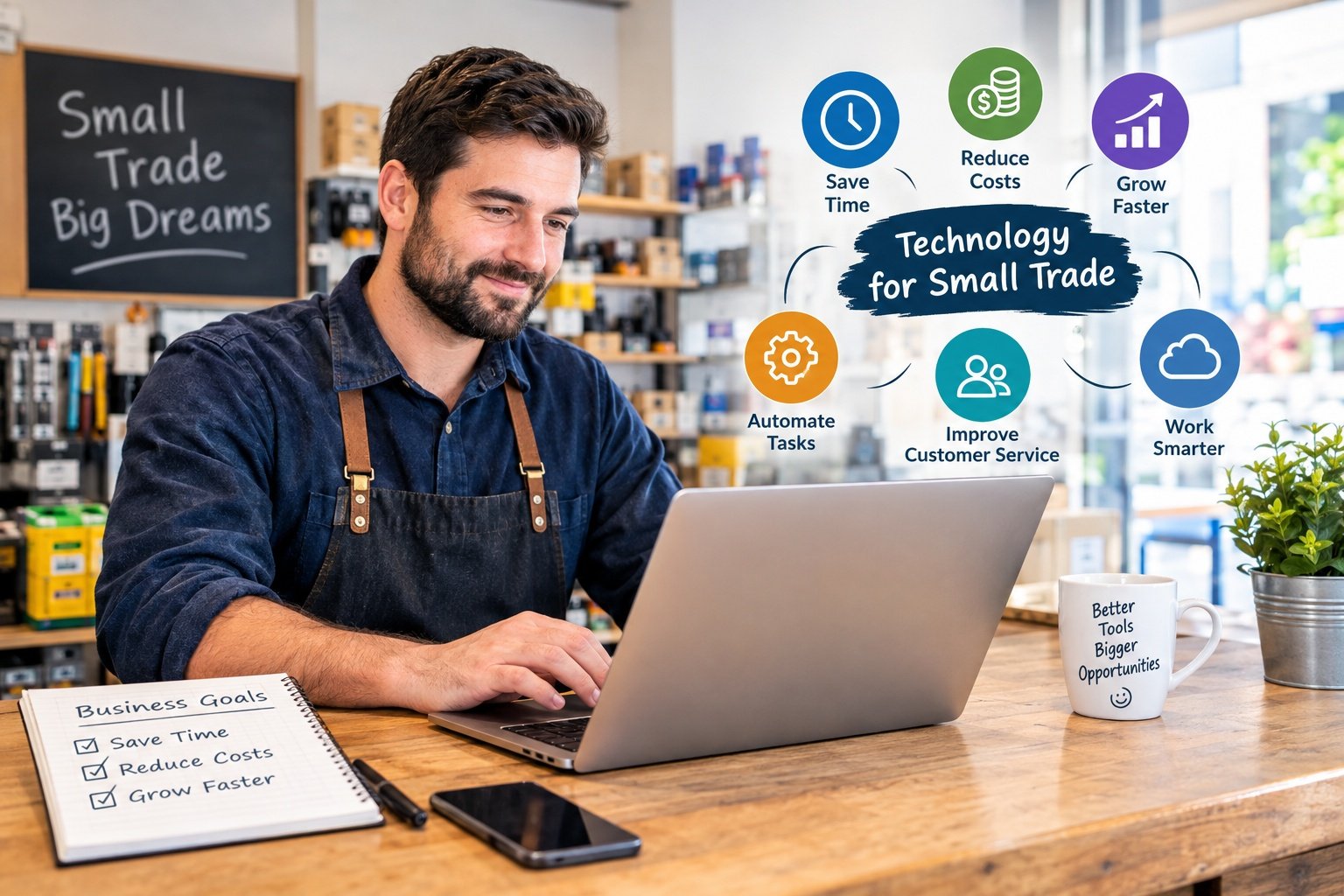
How Technology Can Help Small Trade Companies Save Time, Reduce Costs, and Grow Faster
Technology is no longer something only large corporations can afford or benefit from. Today, businesses of almost every size can use digital tools to work smarter, serve customers better, and control operating costs. This is especially important for Small Trade companies that often have limited staff, tight budgets, and strong competition.
For many Small Trade businesses in the UK and US, everyday operations can involve everything from managing customer enquiries and tracking stock to creating invoices, scheduling jobs, and communicating with suppliers. When these tasks are handled manually, they can consume valuable time and create unnecessary mistakes.
The good news is that modern technology gives Small Trade companies practical ways to simplify these processes without completely changing how they operate. The right tools can automate repetitive work, improve communication, reduce waste, and give business owners more time to focus on growth.
Why Technology Matters for Small Trade Companies
Running a Small Trade business often means wearing several hats at once. An owner may be responsible for sales, customer service, purchasing, accounting, marketing, and operations.
That can quickly become overwhelming.
Technology can take some of that pressure away. Cloud-based software, digital payment systems, accounting platforms, customer relationship management tools, and automation solutions can handle many routine activities in the background.
For a Small Trade company, the goal does not have to be becoming a completely digital business overnight. Instead, technology should solve real business problems.
For example, a tradesperson who spends hours creating quotes could use estimating software. A retailer struggling to track inventory could introduce a cloud-based stock management system. A growing company receiving dozens of customer enquiries could use a CRM platform to keep conversations organised.
Small improvements can eventually create significant results.
Save Valuable Time Through Automation
Time is one of the most valuable resources for any Small Trade business. When employees spend less time on repetitive administration, they have more time available for customers and revenue-generating activities.
Automation is one of the easiest ways to achieve this.
Businesses can automate appointment reminders, invoice notifications, payment confirmations, email responses, stock alerts, and other repetitive tasks. Instead of completing the same activity manually every day, employees can allow software to handle it automatically.
For a Small Trade company, even saving a few hours each week can make a noticeable difference.
Consider a small plumbing business that receives regular service requests. Rather than manually sending appointment confirmations, the company could use scheduling software to automatically notify customers. The owner can then spend that saved time handling additional jobs or improving customer relationships.
Reduce Operating Costs With Better Digital Tools
Reducing expenses does not always mean cutting essential services or reducing staff. For a Small Trade company, it can mean eliminating avoidable inefficiencies.
Digital tools can help businesses identify where money is being wasted.
Inventory management software, for example, can help companies avoid purchasing excessive stock. Accounting software can reduce administrative costs and make financial information easier to manage. Digital documents can also reduce the need for printing, paper storage, and physical paperwork.
Cloud software can provide another financial advantage. Instead of purchasing expensive servers and maintaining complicated IT infrastructure, a Small Trade business can subscribe to cloud-based services and pay for the features it actually needs.
This approach can make technology more accessible to smaller companies operating with limited budgets.
Improve Customer Service
Customers increasingly expect businesses to respond quickly and communicate clearly. A Small Trade company that takes too long to answer enquiries or loses track of customer information may struggle to maintain strong relationships.
Technology can help solve this problem.
Customer relationship management systems allow businesses to keep customer details, conversations, orders, appointments, and follow-ups in one place. Employees can quickly understand what a customer needs without searching through emails, notebooks, or spreadsheets.
For Small Trade businesses, this can create a more professional customer experience.
Automated messages can also keep customers informed. A business can send booking confirmations, delivery updates, payment reminders, and follow-up messages without requiring an employee to send every message manually.
Good technology does not replace personal service. Instead, it gives employees more time to provide it.
Make Better Decisions With Business Data
Another major advantage of technology is access to useful business data.
A Small Trade company may already collect information about sales, customers, expenses, inventory, and employee performance. However, if that information is scattered across notebooks and spreadsheets, it can be difficult to turn it into meaningful insights.
Modern software can bring important information together.
Business owners can see which products sell most frequently, which services generate the greatest revenue, when demand increases, and where costs are rising. This information can support better decisions about pricing, stock, marketing, and staffing.
For a Small Trade business, better information can reduce guesswork.
Instead of relying entirely on instinct, owners can use actual figures to understand what is happening inside the business.
Improve Inventory and Stock Management
Poor inventory management can create significant problems. Overstocking ties up money, while understocking can lead to missed sales and unhappy customers.
Technology can make inventory management much easier for a Small Trade company.
Digital inventory systems can track products as they are purchased and sold. Some systems can automatically notify businesses when stock reaches a particular level. This makes it easier to reorder products before they run out.
For businesses operating across multiple locations, digital systems can also provide a clearer view of available inventory.
A Small Trade business does not necessarily need an expensive enterprise platform. Many affordable cloud-based systems offer basic inventory features that can be expanded as the business grows.
Make Payments Faster and More Convenient
Payment technology has changed significantly in recent years. Customers now expect convenient payment options, including contactless payments, online payments, mobile wallets, and digital invoices.
Offering flexible payment options can benefit a Small Trade company in several ways.
Digital payments can reduce the amount of cash handling required by employees. Online invoicing can make it easier to request and track payments. Automated reminders can also reduce the time employees spend chasing unpaid invoices.
For a Small Trade business, improving the payment process can support healthier cash flow while creating a smoother experience for customers.
This can be particularly useful for companies that provide services at customer locations, where mobile payment options can make transactions much simpler.
Support Remote and Flexible Working
The modern workplace is increasingly flexible, and technology makes this possible even for smaller businesses.
Cloud-based systems allow authorised employees to access important business information from different locations. Team communication platforms can help employees stay connected, while shared documents make collaboration easier.
For a Small Trade company, flexible technology can be particularly useful when employees spend much of their working day away from the office.
A business owner may be able to review sales information from home, approve an invoice while travelling, or communicate with a supplier from a customer location.
This flexibility can make daily operations more efficient without requiring everyone to work from the same physical location.
Strengthen Cybersecurity
Technology also introduces new responsibilities, particularly around cybersecurity.
A Small Trade company may assume that cybercriminals primarily target large corporations. In reality, smaller businesses also need to take sensible precautions because they often hold valuable customer, financial, and business information.
Basic cybersecurity measures can make a major difference.
Businesses should use strong passwords, enable multi-factor authentication, keep software updated, back up important data, and train employees to recognise suspicious emails and links.
For Small Trade companies, cybersecurity should be viewed as part of normal business protection rather than an optional technical expense.
Choose Technology That Solves Real Problems
One of the biggest mistakes a Small Trade business can make is purchasing technology simply because it appears modern or popular.
The right solution should address a genuine business need.
Before adopting a new tool, business owners should ask a few straightforward questions:
- What problem will this technology solve?
- How much time could it save?
- What will it cost initially and every month?
- Will employees be able to use it easily?
- Can it grow with the business?
- Does it integrate with existing systems?
- How will customer and business data be protected?
These questions can prevent unnecessary spending and help a Small Trade company select tools that deliver practical value.
Start Small and Expand Gradually
Technology adoption does not need to happen all at once.
In fact, gradual implementation can be easier for a Small Trade business. Start with one area that causes the greatest amount of frustration or consumes the most time.
For one business, that might be accounting. For another, it could be customer communication, scheduling, stock management, or invoicing.
Once employees become comfortable with the first solution, the company can introduce additional tools.
This approach reduces disruption and gives the team time to learn how technology fits into everyday operations.
The Future of Small Trade Is More Connected
The future of Small Trade is likely to become increasingly digital. Artificial intelligence, automation, cloud computing, mobile applications, and connected business systems are becoming more accessible to smaller companies.
However, technology itself is not the solution. The real advantage comes from using technology thoughtfully.
A Small Trade company that identifies its biggest challenges and chooses appropriate digital tools can improve productivity without losing the personal service that customers value.
Technology should support people, not make business unnecessarily complicated.
Final Thoughts
For a Small Trade company, technology can provide a practical path toward greater efficiency, lower costs, better customer service, and sustainable growth.
The key is to focus on useful solutions rather than chasing every new digital trend. Automating repetitive tasks, improving financial management, organising customer information, tracking inventory, simplifying payments, and protecting business data can all create meaningful improvements.
The most successful technology strategy for Small Trade businesses is often the simplest one: identify a problem, find an appropriate solution, measure the results, and expand gradually.
With the right approach, technology can give Small Trade companies more control over their operations and more time to focus on what matters most — serving customers and building a stronger business.
editor's pick
latest video

news via inbox
Nulla turp dis cursus. Integer liberos euismod pretium faucibua