
How Fast-Growing SaaS Companies Build Billion-Dollar Valuations in the UK and US
The software industry has changed dramatically over the past decade. A small team with a strong idea can now build a product, attract customers across multiple countries, and generate recurring revenue without owning factories, warehouses, or large physical assets. This shift has created an enormous opportunity for SaaS Companies in both the UK and the US.
But what turns an ordinary software business into a company valued at hundreds of millions or even billions of dollars?
The answer is rarely just having a clever product. Fast-growing SaaS Companies usually combine recurring revenue, strong customer retention, efficient growth, a large addressable market, and a business model that can scale quickly. Investors look closely at these numbers because they reveal whether a company can continue growing without costs rising at the same pace.
For founders, understanding these factors is essential. A billion-dollar valuation is not created overnight. It is built through years of product development, customer relationships, financial discipline, and consistent execution.
Why SaaS Companies Attract High Valuations
One of the biggest attractions of SaaS Companies is their recurring revenue model. Instead of selling software once, a SaaS business typically charges customers monthly or annually for continued access to its platform.
This creates greater visibility into future revenue. If a company has thousands of customers paying subscriptions every month, management can make more informed decisions about hiring, marketing, product development, and expansion.
Recurring revenue also makes successful SaaS Companies attractive to investors because predictable income can make future growth easier to model. Of course, recurring revenue alone does not guarantee a high valuation. Investors also consider how quickly that revenue is growing and how efficiently the business acquires and retains customers.
Revenue Growth Is One of the Biggest Drivers
Fast growth is often at the centre of the valuation story.
Imagine two software businesses that each generate $20 million in annual recurring revenue. One is growing at 10% per year, while the other is growing at 80%. Even though their current revenue is identical, investors may view their future potential very differently.
This is why high-growth SaaS Companies pay close attention to annual recurring revenue, or ARR. ARR provides a useful picture of the recurring subscription revenue a business expects from its current customer base.
Rapidly growing revenue suggests that the product is finding demand in the market. However, sustainable growth matters more than growth achieved through uncontrolled spending.
The strongest SaaS Companies therefore try to balance expansion with improving unit economics. They want to acquire more customers while gradually making the cost of acquiring each customer more efficient.
Customer Retention Can Make or Break Growth
Getting customers is important, but keeping them is arguably even more important.
A company may spend thousands of dollars acquiring a new customer. If that customer leaves after a few months, the business may struggle to recover its acquisition cost.
This is why retention is closely watched across successful SaaS Companies. Metrics such as customer churn, net revenue retention, and gross revenue retention provide insight into customer behaviour.
Net revenue retention can be particularly useful because it measures how recurring revenue from an existing customer base changes over time. If customers upgrade, purchase additional products, or increase usage, revenue can grow even without acquiring new customers.
For SaaS Companies, this creates a powerful growth engine. A business with strong retention can grow from its existing customer base while its sales team continues bringing in new accounts.
The Importance of a Large Market
Even an excellent product can struggle if its potential market is too small.
Billion-dollar software businesses typically operate in markets where there is significant room for expansion. This might include cybersecurity, financial technology, artificial intelligence, customer relationship management, enterprise collaboration, healthcare software, or business automation.
The US provides SaaS Companies with access to a huge domestic technology market and a large population of businesses willing to purchase software solutions. The UK offers a strong technology ecosystem as well as access to European and international markets.
Successful SaaS Companies do not necessarily need to dominate an entire industry immediately. Instead, they often begin by solving one specific problem exceptionally well and then expand into related products.
This land-and-expand approach can turn a relatively narrow product into a much broader software platform.
How Pricing Influences Valuation
Pricing is another important part of the valuation equation.
Many SaaS Companies use tiered pricing, allowing customers to choose plans based on features, users, usage levels, or business size. This approach gives companies room to serve startups and small businesses while also moving larger customers toward higher-value enterprise plans.
The goal is not simply to charge more. Effective pricing should reflect the value customers receive.
As a company becomes more established, it may introduce premium features, additional products, usage-based pricing, or enterprise contracts. These strategies can increase average revenue per customer and create additional growth opportunities.
For investors evaluating SaaS Companies, improving revenue per customer can be an important signal that the business has pricing power and a scalable product.
Profitability Matters More as Companies Mature
Growth may dominate the early stages of a software company’s journey, but profitability becomes increasingly important as the business matures.
Some high-growth SaaS Companies deliberately operate at a loss while investing heavily in product development, sales, marketing, and international expansion. The expectation is that these investments will create larger future revenue.
However, investors eventually want evidence that the business can turn revenue into sustainable cash flow.
Gross margin is particularly important for software businesses because digital products can often be delivered to additional customers without proportionally large increases in production costs.
A company with strong gross margins and improving operating efficiency can potentially reinvest in growth while moving toward profitability.
The Rule of Efficient Growth
A useful way to think about mature SaaS Companies is to consider the relationship between growth and profitability.
A company growing rapidly while generating large losses may have an impressive headline growth rate, but its spending needs to be examined carefully. Conversely, a profitable company growing extremely slowly may not have enough expansion potential to command a premium valuation.
The most attractive financial profile often involves a sensible balance between growth and profitability.
This is why management teams increasingly monitor metrics such as customer acquisition cost, lifetime value, payback periods, gross margin, operating margin, and free cash flow.
These numbers help reveal whether growth is genuinely creating value or simply being purchased through excessive spending.
Why the US SaaS Market Is So Significant
The US has become one of the world’s most important markets for cloud software. It has a large base of technology-focused companies, venture capital firms, enterprise buyers, and experienced software talent.
Many successful SaaS Companies use the US as their primary market before expanding internationally.
Enterprise customers can be particularly valuable because large organisations often sign contracts worth significantly more than those of smaller businesses. However, enterprise sales cycles can also take longer and require more sophisticated security, compliance, support, and integration capabilities.
For companies that can successfully navigate this environment, enterprise software can provide substantial recurring revenue.
The UK’s Opportunity for SaaS Companies
The UK has developed its own strong SaaS ecosystem, particularly around London and other technology hubs.
UK-based SaaS Companies can benefit from a mature financial sector, a strong professional services industry, international connectivity, and access to a highly developed business market.
Another advantage is the UK’s position as an international business centre. A successful UK software company can build a domestic customer base and then expand into North America, Europe, Asia, and other markets.
For many SaaS Companies, international expansion becomes a major milestone because it increases the company’s total addressable market.
Technology and AI Are Creating New Opportunities
Artificial intelligence is also changing the growth possibilities for SaaS Companies.
AI can be integrated into existing software products to automate tasks, improve recommendations, analyse information, generate content, or help customers make faster decisions.
However, adding an AI feature does not automatically create a billion-dollar business. Customers still care about reliability, security, ease of use, and measurable business value.
The SaaS Companies that benefit most from AI will likely be those that use the technology to solve meaningful customer problems rather than simply adding AI as a marketing label.
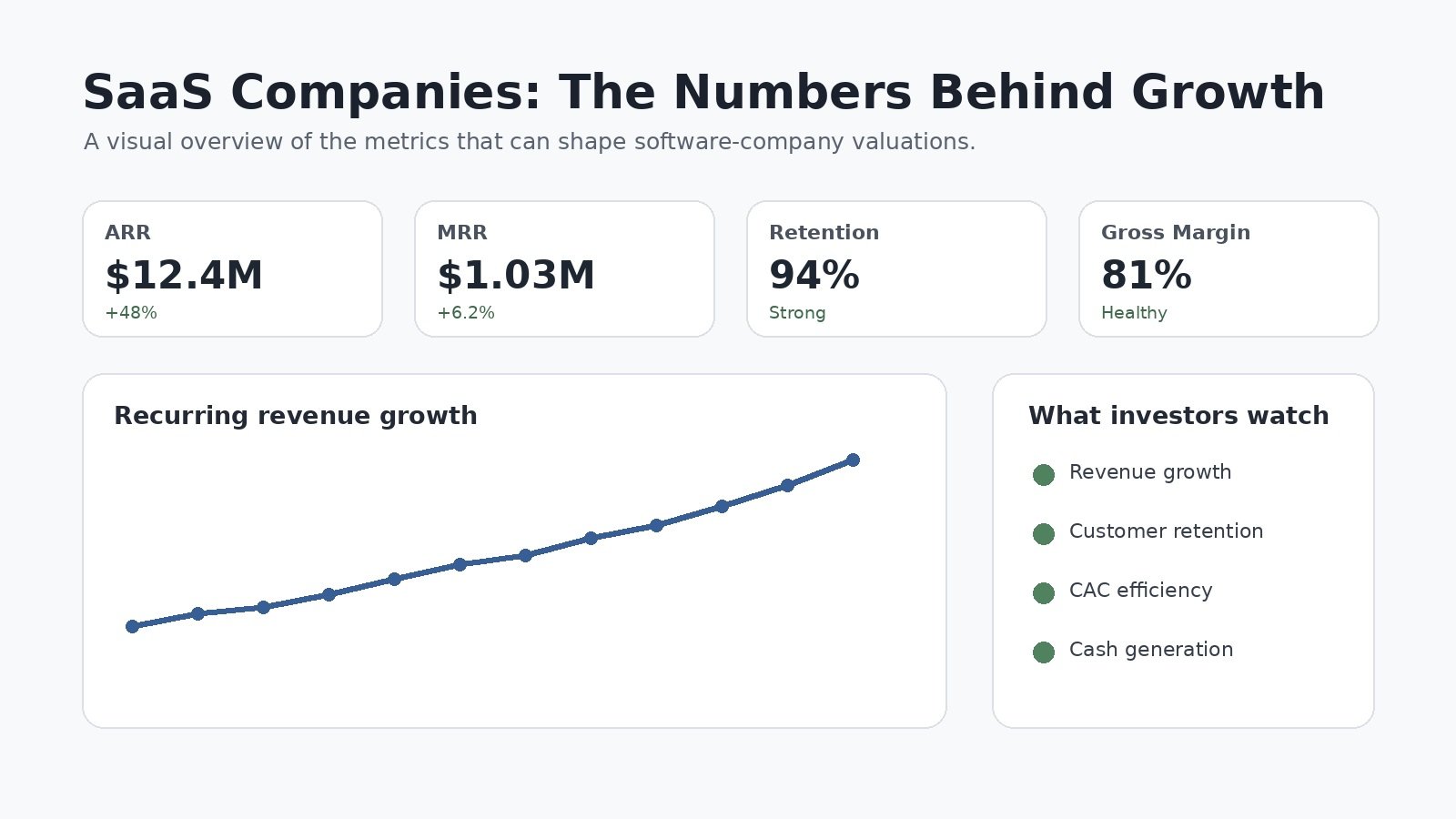
What Investors Look for in High-Growth SaaS Companies
When investors assess SaaS Companies, they typically examine a combination of financial and operational metrics.
These can include:
- Annual recurring revenue
- Revenue growth rate
- Customer retention
- Net revenue retention
- Gross margin
- Customer acquisition cost
- Customer lifetime value
- Free cash flow
- Sales efficiency
- Market size
- Product expansion opportunities
No single metric determines a company’s value.
Instead, investors generally look at the overall quality and sustainability of the business. A company with rapid growth, strong retention, healthy margins, and a large market may present a very different financial picture from one that has rapid revenue growth but weak customer retention and poor cash economics.
Building a Billion-Dollar Valuation Takes Time
For founders, the biggest lesson is that valuation should usually be treated as an outcome rather than the primary objective.
The strongest SaaS Companies focus first on building something customers genuinely need.
That means creating a useful product, listening to users, improving retention, developing repeatable sales processes, controlling unnecessary costs, and expanding into markets where the product can provide measurable value.
Once those foundations are in place, financial performance can begin to compound.
A business that adds customers every month, retains them for years, expands account revenue, and maintains healthy margins can create a powerful economic engine. As revenue and future growth expectations increase, the company’s potential valuation can rise accordingly.
Final Thoughts
The journey from startup to billion-dollar software company is not based on one magic formula. Successful SaaS Companies usually combine several strengths: recurring revenue, strong customer retention, rapid but sustainable growth, attractive margins, efficient customer acquisition, and a market large enough to support continued expansion.
The UK and US offer different advantages, but both provide significant opportunities for ambitious software businesses.
For founders, the focus should remain on building genuine customer value and a scalable business model. For investors, the numbers provide a way to understand whether that model can continue working as the company grows.
Ultimately, the valuation of SaaS Companies reflects expectations about their future as much as their current performance. A company that consistently proves it can attract customers, retain them, increase revenue, and operate more efficiently has the foundation needed to become a major player in the global software market.
editor's pick
latest video

news via inbox
Nulla turp dis cursus. Integer liberos euismod pretium faucibua