
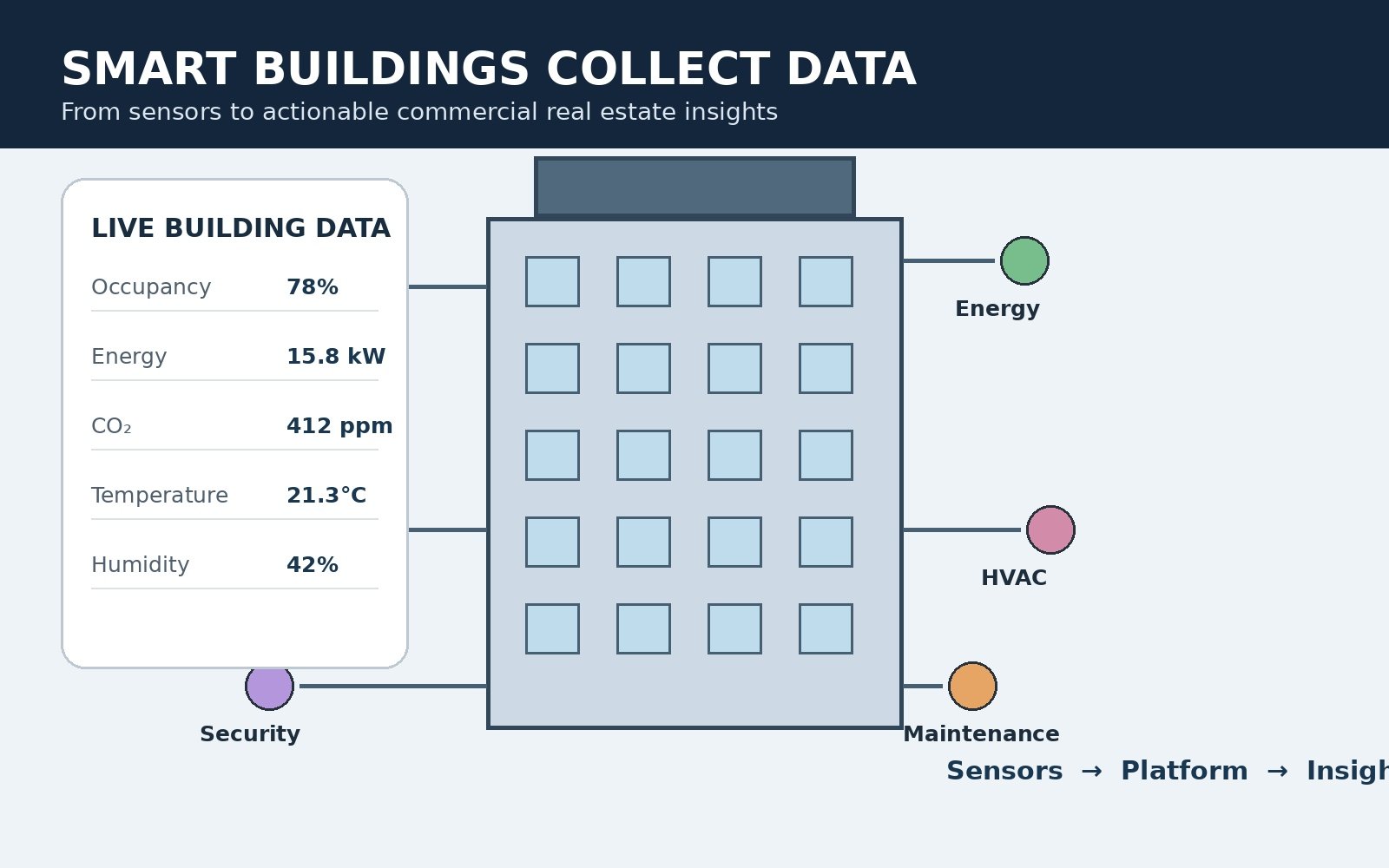
Why Smart Buildings Collect Data and How It Is Changing the Future of Commercial Real Estate
significant reasons businesses are investing in smart building technology.
Commercial buildings can consume substantial amounts of energy through heating, ventilation, air conditioning, lighting, refrigeration, and other systems. When these systems operate without considering real-time conditions, energy can be wasted.
Smart Buildings Collect energy and occupancy information that can help identify where unnecessary consumption occurs.
Imagine an office building with several floors. If one floor is mostly empty on a particular day, its heating and lighting requirements may be different from those of a fully occupied floor. Connected systems can provide information that enables facilities teams to make more informed adjustments.
The result can be a building that uses energy more intelligently instead of simply using less energy through manual restrictions.
For property owners, this can have financial implications as well. Reducing avoidable energy consumption can contribute to lower operating costs, while efficient buildings may also become more attractive to environmentally conscious tenants.
Predictive Maintenance Is Changing Building Operations
Maintenance is another area where building data can make a major difference.
Traditional maintenance often follows a fixed schedule. Equipment may be inspected at predetermined intervals regardless of its actual condition. While scheduled maintenance remains useful, connected technology creates another option.
Smart Buildings Collect performance data from equipment and can identify unusual patterns that may indicate a developing problem.
Consider an air-conditioning system whose energy consumption suddenly increases while its output decreases. That combination could indicate that something requires attention. A facilities team can investigate the issue before the equipment experiences a complete failure.
This approach is often referred to as predictive maintenance.
Rather than waiting for something to break, property managers can use available information to anticipate potential issues. This can reduce unexpected disruptions and help maintenance teams prioritise their workloads.
For tenants, fewer equipment failures can mean a more reliable workplace. For owners, better maintenance planning can support asset longevity and operational efficiency.
Creating Better Tenant Experiences
Commercial real estate is not only about the building itself. It is also about the people who use it.
Employees want comfortable workplaces. Tenants expect reliable facilities. Visitors increasingly expect convenient and technology-enabled experiences.
Smart Buildings Collect information that can help property teams understand these expectations.
For example, occupancy information can reveal which amenities are popular and which areas are rarely used. Indoor environmental data can help teams understand whether temperature and air quality remain comfortable throughout the property.
Some smart buildings can also support digital access systems, automated lighting, smart meeting rooms, and connected workplace services.
These features can make buildings more responsive to the people using them.
The result is a shift from managing a building as a static asset toward managing it as a dynamic environment.
Data Can Help Commercial Real Estate Owners Make Better Decisions
One of the biggest advantages of building data is that it can support evidence-based decision-making.
Property managers regularly need to make choices about maintenance, renovations, energy systems, space allocation, security, and tenant services.
Without reliable information, these decisions may depend heavily on assumptions or limited observations.
Smart Buildings Collect data that can provide additional context.
Suppose a property owner is considering whether to renovate a particular area. Occupancy information might show that the space is consistently underused. Alternatively, the same data could reveal that demand is increasing and additional investment may be justified.
Data does not eliminate the need for human judgement. Instead, it gives decision-makers more information to consider.
That distinction is important because technology should support property professionals rather than attempt to replace them.
The Role of Artificial Intelligence
Artificial intelligence is adding another layer to smart building technology.
Modern AI systems can analyse large quantities of information much faster than a person could manually review individual data points. This creates opportunities for detecting patterns, identifying anomalies, and supporting automation.
As Smart Buildings Collect increasingly detailed information, AI can potentially help property teams interpret that information more effectively.
For example, an AI-powered system could analyse historical energy usage alongside weather conditions, occupancy patterns, and equipment performance. It could then identify trends that may not be obvious from individual measurements.
AI can also support automated recommendations. A system might identify unusual energy consumption or suggest adjustments to building operations based on historical patterns.
However, automation should be implemented carefully. Building owners still need appropriate oversight, reliable data, cybersecurity controls, and clear processes for responding to automated recommendations.
Security and Privacy Must Remain Priorities
The growing use of building data also creates important responsibilities.
Smart Buildings Collect information that can sometimes reveal how spaces are used and when people are present. Depending on the technologies involved, building systems may handle information that requires careful protection.
Cybersecurity therefore becomes an essential part of smart building management.
Connected systems need appropriate access controls, software updates, network security, monitoring, and data governance. Building owners also need to understand what information is being collected, why it is necessary, how long it is retained, and who can access it.
Privacy considerations are particularly important when technologies can be associated with individuals rather than simply measuring general building conditions.
A successful smart building strategy should therefore balance convenience and efficiency with responsible data management.
Smart Buildings and Sustainability
Sustainability is becoming increasingly important across commercial real estate markets in both the UK and US.
Companies are examining the environmental impact of their offices and facilities, while property owners are looking for practical ways to improve building performance.
Smart Buildings Collect operational information that can help identify opportunities to reduce waste and improve resource efficiency.
Energy monitoring can reveal inefficient equipment. Occupancy information can help prevent unnecessary heating and cooling. Automated lighting systems can respond to actual usage rather than operating continuously.
These capabilities do not automatically make a building sustainable, but they provide useful information for achieving sustainability goals.
For commercial landlords, this can also become part of the wider conversation around attracting and retaining tenants who place greater importance on environmental performance.
The Future of Commercial Real Estate Will Be More Data-Driven
The future commercial building is likely to be more connected, responsive, and data-driven than the buildings of previous generations.
As sensor technology becomes more accessible, Smart Buildings Collect greater amounts of information from increasingly diverse sources. Cloud platforms, AI, automation, digital twins, and advanced analytics can then help transform that information into practical insights.
This could change how properties are designed and operated.
Instead of designing a building based entirely on expected usage, developers may increasingly consider how real-world operational data can inform future projects. Existing properties may also be upgraded with connected systems rather than relying solely on large-scale redevelopment.
The commercial real estate industry could therefore move toward a continuous improvement model, where buildings are monitored, analysed, adjusted, and improved over time.
What This Means for UK and US Property Markets
For property professionals in the UK and US, smart building technology represents more than a technology upgrade.
It can influence operating costs, tenant experience, maintenance strategies, sustainability programmes, and long-term asset management.
Smart Buildings Collect data that can help property owners understand what is happening inside their assets. That visibility can become particularly valuable in large portfolios where manually monitoring every building is difficult.
The technology may also help organisations respond to changing workplace patterns. As hybrid and flexible working continue to influence office occupancy, real estate companies need better information about how spaces are actually being used.
Rather than assuming that every floor or facility operates in the same way, data can provide a more detailed view.
The Bottom Line
The rise of smart building technology is changing the relationship between physical property and digital information.
Smart Buildings Collect data because modern commercial properties need better ways to understand energy use, occupancy, equipment performance, environmental conditions, security, and tenant needs.
The real opportunity lies beyond simply gathering information. When properly managed, building data can help property teams identify inefficiencies, plan maintenance, improve workplace experiences, and make more informed decisions.
For commercial real estate owners and operators across the UK and US, this shift could become an increasingly important part of long-term property strategy.
The buildings of the future will not simply provide space. They will continuously generate information about how that space works. Businesses that understand how to responsibly use that information will be better positioned to adapt as technology, workplace expectations, and sustainability requirements continue to evolve.
editor's pick
latest video

news via inbox
Nulla turp dis cursus. Integer liberos euismod pretium faucibua