
How the Cost of Delaying Legacy Modernization Impacts Business Growth
Technology moves quickly. What was considered modern five or ten years ago can easily become a limitation today. Yet many businesses in the UK and US continue to rely on legacy systems because replacing them feels expensive, complicated, or risky.
At first glance, postponing modernization may appear to be a sensible way to save money. After all, if an existing system still works, why replace it? The problem is that “still working” does not necessarily mean “still supporting the business.” Older systems can quietly increase operating costs, slow down employees, create security concerns, and make it harder for companies to respond to changing customer expectations.
This is where the Cost of Delaying legacy modernization becomes important. The financial impact is rarely limited to the price of outdated software. It can affect productivity, security, customer experience, innovation, and long-term growth.
For businesses planning their technology strategy, understanding the Cost of Delaying modernization can help turn a difficult technology decision into a practical business conversation.
What Is Legacy Modernization?
Legacy modernization is the process of updating older applications, infrastructure, databases, and technology platforms so they can better support current business requirements.
Modernization does not always mean completely replacing an existing system. Depending on the organisation, it may involve moving applications to the cloud, updating old software, improving integrations, restructuring databases, replacing individual components, or rebuilding applications using modern technologies.
The right approach depends on the company’s goals, budget, risk profile, and existing technology environment.
However, continuing to postpone the process can increase the Cost of Delaying modernization. The longer an outdated system remains at the centre of business operations, the more difficult it can become to maintain and eventually replace.
The Cost of Delaying Can Reduce Business Productivity
One of the most noticeable effects of outdated technology is reduced productivity.
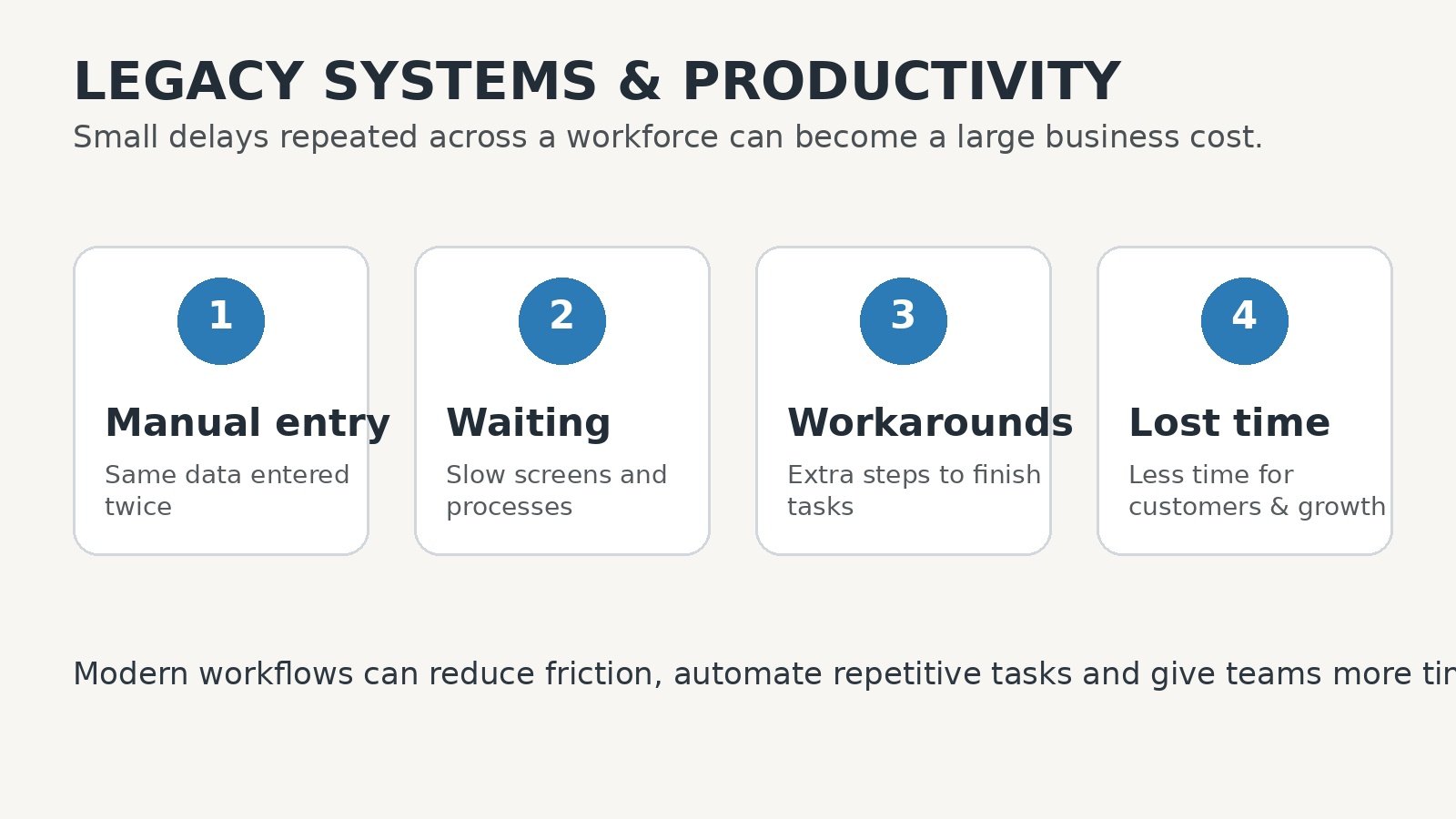
Employees may spend unnecessary time waiting for applications to load, entering the same information into multiple systems, working around software limitations, or manually completing processes that could be automated.
These small inefficiencies can become significant when multiplied across an entire workforce.
For example, imagine hundreds of employees losing only a few minutes each day because of slow systems or inefficient workflows. Over a year, those minutes can represent thousands of hours of lost productivity.
This is one reason the Cost of Delaying modernization should be considered in terms of business performance rather than software expenditure alone.
Modern platforms can provide better automation, integration, accessibility, and reporting. When employees have technology that supports rather than obstructs their work, businesses can potentially devote more time and resources to customers, innovation, and growth.
Rising Maintenance Costs Are Another Warning Sign
Older systems often require specialised knowledge to maintain. In some organisations, the people who originally developed or implemented these systems may have already moved on.
That can make finding qualified support increasingly difficult.
Businesses may also need to maintain outdated hardware, unsupported software versions, custom integrations, and older programming languages. As vendors discontinue products and skilled professionals become harder to find, maintenance expenses can increase.
The Cost of Delaying modernization therefore has a compounding effect. A company may initially avoid a large modernization project, but continue paying smaller maintenance and support costs year after year.
Eventually, those recurring expenses can become substantial.
Instead of looking only at the immediate modernization budget, decision-makers should compare it with the long-term cost of maintaining the current environment.
Security Risks Can Increase Over Time
Cybersecurity is another major consideration.
Legacy systems may not have been designed for today’s threat environment. Older applications can lack modern security features, receive limited vendor support, or depend on outdated components that are difficult to patch.
This does not mean every legacy system is automatically insecure. Proper controls, monitoring, segmentation, and security practices can reduce risk. However, older technology can make maintaining an effective security posture more challenging.
The Cost of Delaying modernization can become particularly serious when a security incident affects business operations, customer information, or regulatory obligations.
For organisations handling sensitive information, technology modernization should therefore be considered alongside broader cybersecurity and risk-management strategies.
Customer Expectations Are Changing
Customers rarely care whether a company is using a legacy platform. They care about the experience that technology creates.
They expect websites and applications to be responsive, services to be convenient, information to be accurate, and support to be available when they need it.
If outdated technology creates slow processes, limited digital services, or inconsistent customer experiences, customers may become frustrated.
The Cost of Delaying modernization can consequently appear in areas that are harder to measure, such as customer satisfaction and retention.
Modern technology can help organisations create smoother digital experiences and connect information across departments. While modernization alone cannot guarantee customer loyalty, outdated systems can create unnecessary barriers.
Legacy Technology Can Slow Innovation
Innovation requires flexibility.
Businesses need to experiment with new products, integrate emerging technologies, analyse data, and respond to market changes. Legacy systems can make these activities more difficult when they were built around older architectures or rigid processes.
A company may have a promising new idea but discover that connecting it to an old system requires months of development.
This is another important part of the Cost of Delaying modernization. The business is not simply paying for an old system; it may also be paying through missed opportunities.
Modern architectures and APIs can make it easier to connect applications and introduce new capabilities. For businesses competing in technology-driven markets, that flexibility can become increasingly important.
The Cost of Delaying Can Affect Employee Experience
Technology affects employees just as much as it affects customers.
People expect workplace tools to be reliable and reasonably easy to use. When employees regularly encounter outdated interfaces, repetitive manual tasks, system outages, or complicated workflows, frustration can build.
Poor technology does not necessarily cause employees to leave, but it can contribute to an environment where people spend too much time dealing with systems rather than doing meaningful work.
The Cost of Delaying modernization may therefore include lower efficiency and employee dissatisfaction.
Integration Becomes More Difficult With Older Systems
Most modern businesses rely on multiple applications.
A company might use separate systems for finance, customer relationship management, human resources, analytics, marketing, inventory, and communication.
These systems need to exchange information.
Legacy platforms can make integration difficult because they may rely on outdated interfaces, custom connectors, or processes that were never designed for today’s interconnected technology environment.
The Cost of Delaying modernization can grow as more systems are added around an outdated core platform.
Instead of simplifying the technology environment, businesses can end up creating additional layers of workarounds. Over time, this can increase technical complexity and make future modernization even more challenging.
Modernization Does Not Have to Mean “Replace Everything”
One common misconception is that modernization requires an organisation to replace its entire technology environment at once.
That is rarely necessary.
Businesses can take a phased approach. They can identify the most critical systems, assess dependencies, prioritise high-risk components, and modernize gradually.
For example, a company might begin by moving selected workloads to the cloud, modernising an important customer-facing application, introducing APIs, or replacing a particularly problematic component.
This approach can help manage the Cost of Delaying while reducing the operational risks associated with a massive technology transformation.
A well-planned roadmap allows businesses to modernize according to priorities rather than attempting to change everything simultaneously.
How Businesses Can Measure the Cost of Delaying
Before making a modernization decision, businesses should look beyond the initial technology investment.
A useful assessment can include:
- Annual maintenance and support expenses
- Employee productivity losses
- System downtime and disruption
- Cybersecurity exposure
- Cost of specialist legacy skills
- Integration and development expenses
- Customer experience problems
- Missed automation opportunities
- Difficulty launching new products or services
- Future migration complexity
This broader view makes the Cost of Delaying easier to understand.
Businesses should also consider the total cost of ownership rather than focusing exclusively on the purchase price of new technology.
A modern platform may require significant investment initially, but an older platform can continue generating costs for many years.
Building a Practical Modernization Strategy
Successful modernization begins with understanding the current technology environment.
Businesses should document their applications, infrastructure, integrations, data dependencies, and business-critical processes. From there, technology leaders can identify which systems create the greatest operational or strategic challenges.
The Cost of Delaying should be assessed alongside business priorities rather than treated as a purely technical issue.
A practical modernization strategy may include:
- Assess the existing environment
Identify outdated, expensive, unsupported, or business-critical systems. - Define measurable objectives
Establish goals such as improved productivity, stronger security, lower maintenance costs, or faster product development. - Prioritise systems
Start with areas where modernization can deliver meaningful business value. - Create a phased roadmap
Break a large transformation into manageable stages. - Measure results
Track costs, productivity, performance, security improvements, and business outcomes.
This approach can make modernization more manageable and reduce unnecessary disruption.
The Cost of Delaying Is Also a Strategic Cost
Perhaps the most important point is that the Cost of Delaying is not simply an IT expense.
It is a strategic business issue.
When technology prevents a company from moving quickly, serving customers effectively, protecting information, or introducing new products, the impact reaches beyond the IT department.
Executives and business leaders should therefore discuss modernization in terms of growth, risk, productivity, and competitiveness.
The question is not simply, “How much will modernization cost?”
A better question is, “What will it cost the business if we continue operating this way for another three, five, or ten years?”
Conclusion
Legacy systems can remain useful for many years, but businesses should not confuse familiarity with long-term sustainability.
The Cost of Delaying modernization can appear gradually through higher maintenance expenses, reduced productivity, security challenges, integration problems, employee frustration, and slower innovation.
Modernization does not have to be a disruptive, all-at-once transformation. With careful planning, businesses can prioritise critical systems, modernize in stages, and align technology investments with measurable business objectives.
For organisations in the UK, US, and other competitive markets, the real issue is not whether every legacy system needs to disappear immediately. The important question is whether the current technology environment is helping the business move forward or quietly holding it back.
Understanding the Cost of Delaying gives business leaders a clearer way to answer that question and build a technology strategy that supports sustainable growth.
editor's pick
latest video

news via inbox
Nulla turp dis cursus. Integer liberos euismod pretium faucibua